Evolving viscoelasticity

Solid rocket motor response

Capture broadband, history-dependent material response with a compact fractional-hybrid model.

Solid rocket motor response schematic overview
Engineering context

The challenge and the Phractals approach.

Engineering challenge

Propellant and other viscoelastic materials respond across broad time scales, and their constitutive behavior can evolve with operating conditions. A compact standard Prony model may not reproduce that changing response with sufficient fidelity.
Phractals approach

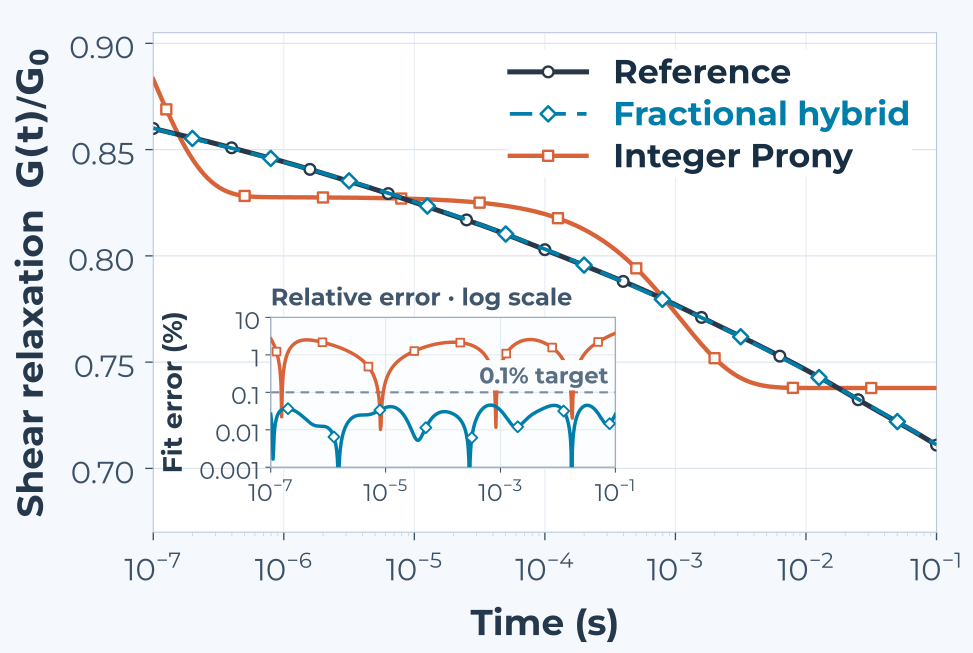
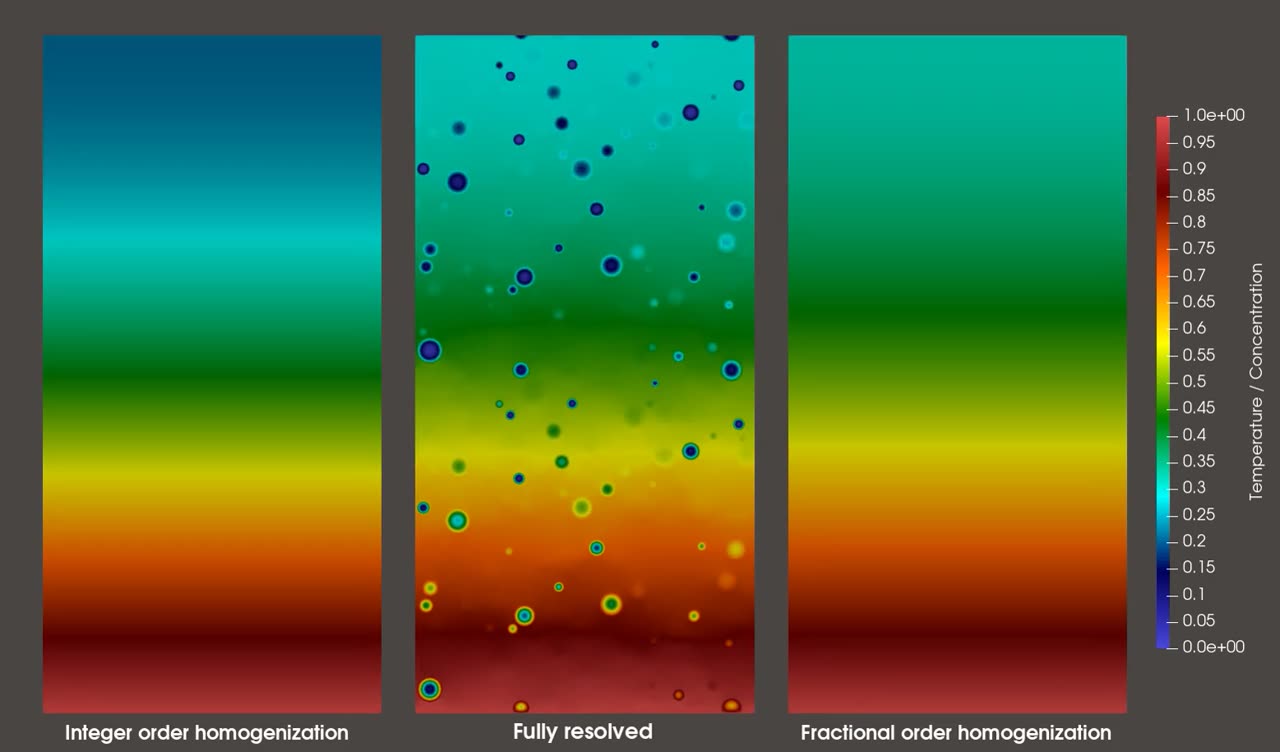
Phractals combines fractional and classical model elements to represent long material memory without requiring a large expansion of discrete relaxation branches. The comparison keeps the numerical reference, hybrid prediction, and integer-order baseline visible together.

Simulation examples

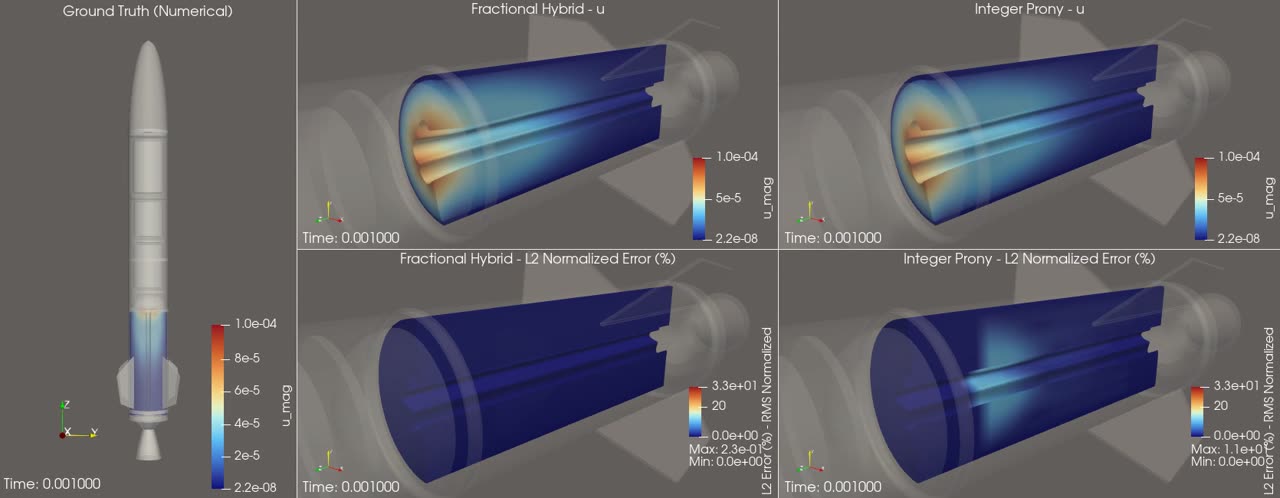
The animation compares ground-truth displacement with a fractional-hybrid model and a standard integer-order Prony model using the same parameter count, while the lower panels expose normalized error across the motor section.

Fractional-hybrid versus Prony response

Ground truth, fractional-hybrid, and integer-order Prony displacement fields are paired with their normalized errors.

RMS material-fit error comparison

RMS material-fit error comparison

The hybrid formulation preserves the material-fit reference while requiring far fewer model parameters and reducing the RMS error compared with the equivalent Prony baseline.

Engineering value

Why this application matters.

Represent broadband creep, relaxation, and damping with compact models.

Expose where a conventional constitutive baseline diverges from the numerical reference.

Improve confidence in simulations that depend on long loading and operating histories.

Technical discussion or pilot evaluation

Bring us your data and modeling challenges.

We will identify whether this Phractals workflow fits your engineering decision.

Discuss a pilot