Thermal conduction in microstructured and heterogeneous materials can depart from a Fourier transport baseline. Resolving every inclusion can preserve the physics, but it also creates models that are expensive to build, calibrate, and solve.
Reduced-order thermal conduction
Retain thermal-memory effects and microscale behavior without resolving every feature in the production model.
The challenge and the Phractals approach.
Phractals uses fractional homogenization to represent the influence of unresolved microstructure in a compact continuum model. The workflow illustrated below shows classical, fully resolved, and Phractals responses side by side to facilitate the comparison.
Two illustrative examples are presented for the thermal-conduction application: a reduced-order microstructure example and a multichannel (idealized) fractured-path example. Each family highlights a different challenge in how heat spreads through complex media.
Thermal transport in microstructured materials
This example focuses on unresolved microscale heterogeneity and reduced-order transport: the goal is to preserve the effective thermal response while removing the cost of fully resolving every detail of the microstructure.
2D homogenized model
The comparison shows the thermal transiet response of (left to right) the integer-order homogenized, the fully resolved microstructure, and the Phractals homogenized models.
3D homogenized model
The comparison shows a similar scenario to that simulated in the 2D case. The video shows the thermal transiet response of the (left to right) the integer-order homogenized, the fully resolved microstructure, and the Phractals homogenized models.
Thermal transport in multi-branched pathways / fracture networks
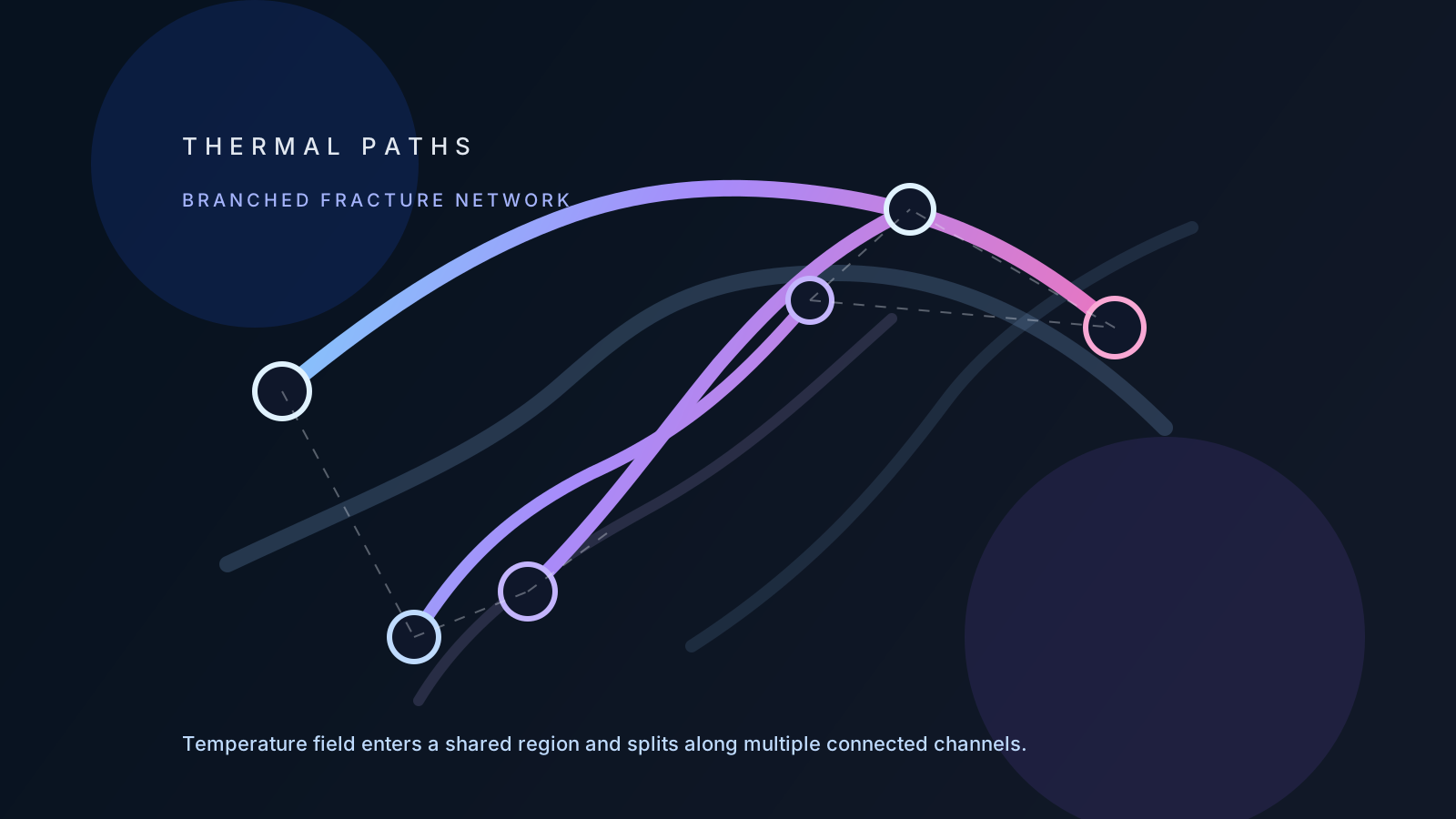
This case targets a different thermal challenge: heat flow through connected, branching pathways, where transport is distributed across multiple channels and the macroscopic response depends on network geometry and connectivity.
Transient thermal response in multichannel pathway
The time-dependent temperature fields and relaxation curves are presented for the classical (integer-order) homogenized, the fully resolved, and the Phractals homogenized models.
Why this application matters.
Evaluate microstructured thermal systems with dramatically smaller computational models.
Preserve delayed transport and thermal-memory behavior that a classical baseline can miss.
Compare reduced and resolved responses before committing to a production workflow.

Solid rocket motor response
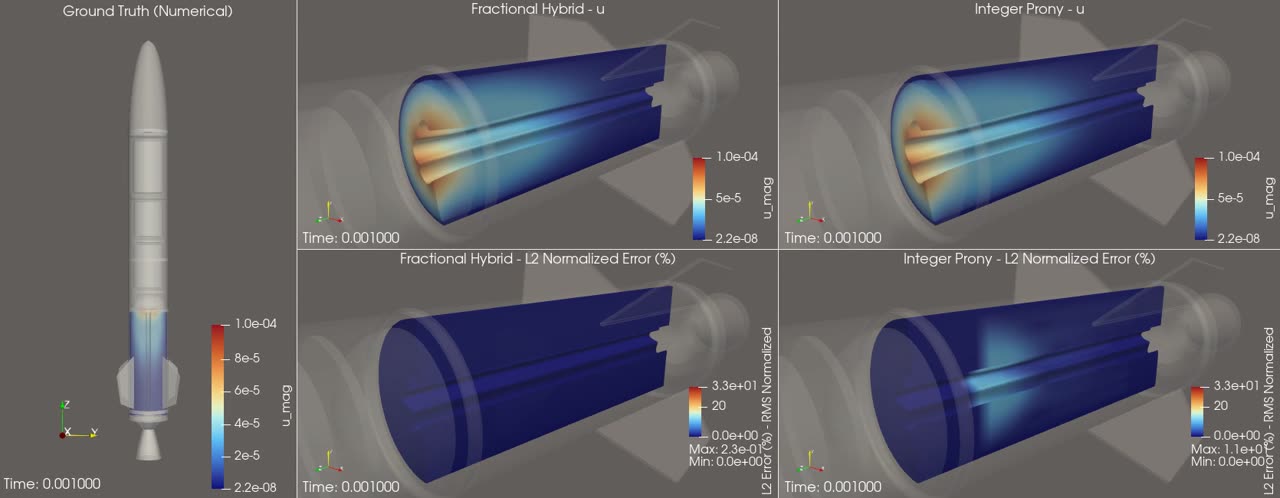
Capture broadband, history-dependent material response with a compact fractional-hybrid model.
Explore the case
Biomaterial dynamics
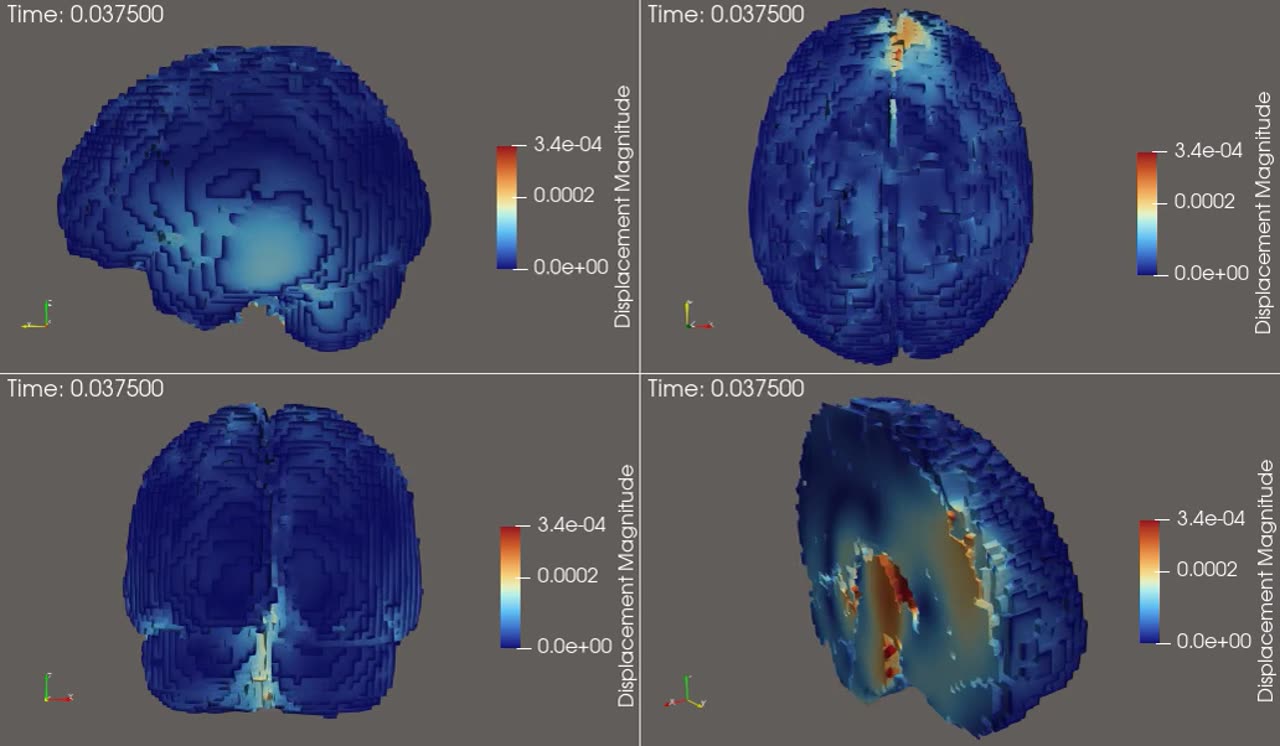
Study transient deformation in compliant, heterogeneous materials where damping and history shape the response.
Explore the case
Coupled thermo-mechanics
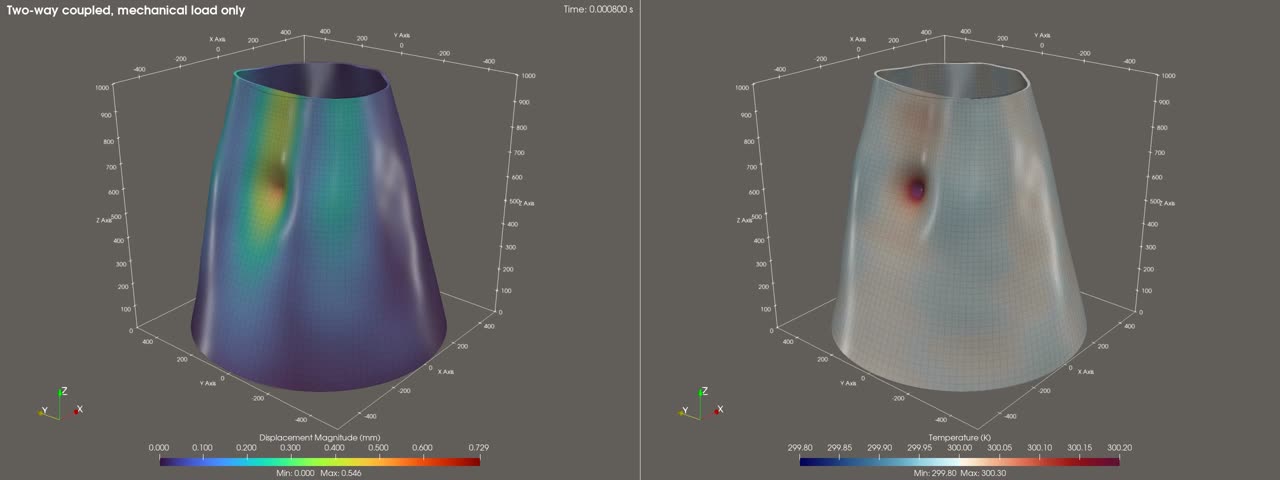
Couple temperature and deformation in a two-way workflow without building a custom coupling chain.
Explore the caseBring us your data and modeling challenges.
We will identify whether this Phractals workflow fits your engineering decision.